We are meeting at the Tynemouth Castle at 7:30pm for all who want to join us. This weeks blog is by Hilary Day, with a little help from Caleb Day.
A wee while ago, we did a series of blogs on our favourite pieces of art and media. I wasn’t organised enough to submit a blog for that series, so this is the blog I would’ve submitted.
Mad Max: Fury Road is one of my favourite movies. It is a bombastic spectacle with larger than life, bad-ass characters, and, in my opinion, it explores some pretty interesting themes. It may surprise people that a movie that is essentially a two-hour car chase across the desert, interspersed with fight scenes, makes me think deeply about heavy theological concepts like eschatology and climate grief. But it does.
Ahead are plot spoilers for Mad Max: Fury Road.
The Mad Max series (1979-present) follows an alternate history of Australia after global societal collapse, gradually descending into a post-apocalyptic wasteland. Fury Road, the fourth film after a 30 year gap, finds the world dominated by warlords controlling resources and people through private armies and religions worshipping them.
The film begins with Max imprisoned by one such warlord: the movie’s baddy, Immortan Joe. Immortan Joe is the violent and dictatorial leader of the Citadel – the only place in acres of desert with fresh water and produce. Most people beg to access some of that food and drink, while Immortan Joe lives in luxury and is focused on breeding heirs through enslaved “wives.”
So why does Mad Max: Fury Road make me think so deeply about eschatology? And, more importantly, what even is eschatology?
Let’s answer the second question first: Eschatology in religious and other worldviews is about expectations of endings (good or bad): the end of an era, a civilisation, all of humanity, or the whole world. So you know, simple stuff.
Eschatology is too big for my little brain to fully understand, and actually, I’m fine with that. I am very skeptical of anyone who says they have the answers and lays out a step-by-step revelation of the end times or life after death, saying this will happen and then this will happen and then five horses will come and then some people will fly and the angels will be this tall. I don’t think it’s possible to understand.
There are also some quite different ways Christians have understood eschatology over the years. What’s generally agreed is some sense that God will save people from suffering and evil in this broken world, that this involves some sense of living eternally with God, and that this somehow relates to the resurrection of Jesus. Many Christians also believe that – like Jesus’ resurrection – there will be some suffering and destruction first… bad endings before the good ending.
This points to one connection with the movie: Are we headed for something like a Mad Max apocalyptic wasteland?
Everyday, apocalyptic wastelands feel closer than ever. We’ve just had the hottest summer on record, which is only the beginning of the effects of climate breakdown. Scientists warn that we are mere months away from the climate tipping point of 1.5 degrees heating in global temperature. It seems less and less likely that our governments and institutions will prevent even a 2 degree rise, or more.
When I see our leaders again and again failing to do anything substantive about global warming and ecosystem destruction, or other major risks like AI or war or disinformation that gives rise to violence, I despair. I am angry. I am sad. I am scared.
One version of Christian eschatology suggests an answer to these massive threats to the world: God will free us from this world. It’s bound for destruction, and ultimately God will finish it off. We’ll go to heaven instead. We’ll escape.
In Mad Max: Fury Road, the characters also yearn to escape. Immortan Joe secures the loyalty of his soldiers by promising to take them to Valhalla. Those who don’t believe in Immortan Joe’s eschatology instead seek paradise across the desert. Max joins a one-armed truck driver named Imperator Furiosa as she rescues Immortan Joe’s five “wives.” Furiosa is taking the women to safety in the Green Place – the verdant land where she grew up.
Sometimes, as I look at my social media feed or walk through where I live in North Shields or listen to a news podcast, hearing about violence, oppression, greed, famine, war, illness – I think that there must be somewhere else that’s an abundant sanctuary, because the here and now feels really, really awful.
However, there are some problems with eschatologies of escape from this world. The author Wendell Berry, who died recently, explores this idea in his 2000 novel Jayber Crow. The title character muses about how sermons at his local church were often focused on a heaven elsewhere, disregarding the paradises God has already created on earth, and denigrating the world as distraction and temptation. He is confused by “…this religion that scorn[s] the beauty and goodness of the world,” and thinks the preachers have “learned to have a very high opinion of God and a very low opinion of His works – although they could tell you that this world had been made by God Himself.” Does God not care about the destruction of God’s works – will God even destroy it Themself?
Another problem is highlighted by Bob Marley in his song ‘Get Up, Stand Up’:
Most people think great God will come from the sky
Take away everything, and make everybody feel high
But if you know what life is worth
You would look for yours on Earth
And now you see the light
You stand up for your right, yeah
If this life and Earth, God’s wonderful creation, is worthwhile, shouldn’t we look for that worth here? Not escape the world, but cherish and care for it, like we do our loved ones and our gardens? Not give up our world and lives to the systems that could destroy them, but stand up for our rights?
This is something like where Mad Max: Fury Road ends up (and here’s the big spoilers).
Furiosa and co succeed in escaping and getting to where the Green Place was meant to be. But they find that the Green Place no longer exists. It is now an uninhabitable marshy-wasteland.
Max persuades Furiosa to go back and liberate the Citadel from Immortan Joe, arguing that the Citadel is the Green Place now as it has water and fresh food and has the potential to be the sanctuary she is searching for. They go back and start to lead the people to overthrow Immortan Joe’s regime, share the resources he was hoarding, and remake the Citadel.
Is this, then, the solution? To commit to this world, and get stuck in, working to transform it, to liberate ourselves and all of creation? Should we maybe even give up the idea of God as saviour or liberator, if that’s a distraction from the fact that liberation is up to us?
This eschatology, where only humans are saviours, also does not sit right with me. If our liberation is all up to us, that kinda scares me even more. We are failing so badly as a species to fix these global problems and threats we have caused. In many ways we’re making it worse. And even when we try, how can us little people do anything against the power, wealth, and influence of the systems and companies making money from the problems?
I don’t want to be saved from the world. I want the world to be saved, and I agree that we need to get stuck in to help save it. But I also think the world needs a saviour, with power beyond this world.
Some theologians have set out different conceptualisations of eschatology that offer some insight into the world’s future, our eternal destiny, and the final relationship between creation and heaven. The one that resonates most strongly with me is the idea that God wants to redeem the world we currently live in. There’s not some other place that we’re going to when we die or when the end times come or whatever. We are not going to heaven: God is bringing heaven here, uniting God with creation, as a new (or renewed) heavens and earth (Isaiah 65; Revelation 21–22).
What matters is this earth, this world, this planet. That is what God cares about.
The theologian Tom Wright argues that the narrative of the Bible is about the kingdom of God coming to earth (as Jesus and the church prays: your kingdom come; your will be done on earth as in heaven), and “God’s plan is not to abandon this world … Rather, he intends to remake it … That is the promise of the Christian gospel.” From declaring creation good in the Bible’s first chapter to promising to renew it in the last two chapters, God is committed to this earth. And God gets stuck in to fix it – even to the point of becoming part of creation in Jesus.
I see Mad Max: Fury Road as a great exploration of this idea. For the first two thirds of the movie, Furiosa is fixated on getting to the Green Place – that place elsewhere where things are good, where she and the wives will be safe, where there is abundance and hope and peace. But the Green Place does not exist. And actually, it is the Citadel where things can be good, can be all she imagined the Green Place to be.
One difference between Mad Max: Fury Road and my understanding of eschatology is that salvation in the movie is found through violence and strength. The car chases and fight scenes lead to a heck of a lot of death and destruction, with the good guys murdering the bad guys at the end. Jesus’s story is not one where he kills the baddies through strength and violence. In fact, the baddies kill him. Jesus enters into human life, human suffering, and even human failure, being executed by the empire like all the other failed messiahs. But God’s liberation comes through resurrection, despite failure in human terms. And that’s how God promises to save our world: through resurrection. I find this gives me hope at times when I see little reason for optimism in human terms.
This view of eschatology – finding God’s kingdom on earth instead of ‘up in heaven’ – is one of the few things that brings me solace in the face of the current climate crisis and other threats and crises. When I find myself yearning for escape, I try to remember Isaiah 65’s vision of new heavens and new earth including justice and peace in this world, and hold on to the idea that God loves this good world and will resurrect it. I find hope in the idea that God doesn’t want to take us away elsewhere, but joined us here. God’s heart breaks over the violence, oppression, greed, famine, war, illness, ecological destruction, and threats of extinction that happen in the world God created. God is with us in the suffering, and we are with God in the liberation.
I don’t think that Mad Max: Fury Road is a complete and thorough exploration of the kingdom of heaven coming to earth. But it does challenge me to remember that the safe place, the place of abundance and peace, is not going to happen elsewhere, it’s going to happen here.
Questions:
- Do you have a favourite action movie?
- What did you think heaven would be like when you were a kid?
- Are there any pieces of media or art that you like which describe heaven in some way?
- What do you think heaven is like?
- What would you like to see transformed in this world?
- Is there anything that brings you comfort in the face of the climate crisis and other global/existential crises?
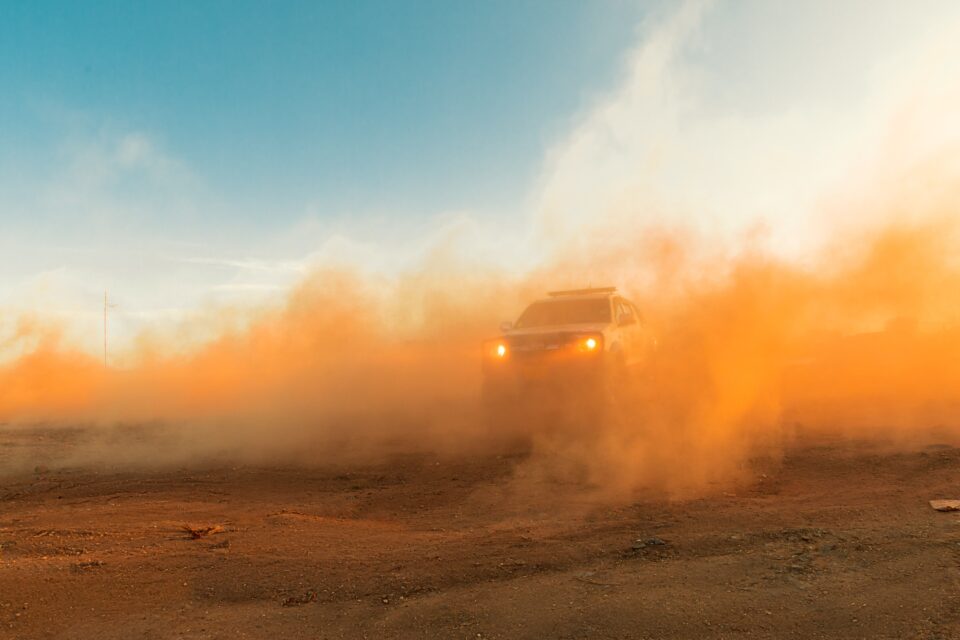
Photo by Moses Londo: https://www.pexels.com/photo/4×4-truck-on-a-desert-10099902/

Has been a part of BeachcomberFX since his arrival in the North East in 2014. He is well travelled (at least in the UK) having lived in Manchester, Nottingham, Derbyshire, Southport, Doncaster, Berwick and Edinburgh. Supporter of Newcastle United, will watch any sport.