Hey folks, we are meeting at the Enigma Tap at 7.30 this Sunday, I hope you can join us.
Well, we’ve hit that time of year again when the clocks change and those of us who love the summer and the light evenings begin to struggle, while those who love hunkering down for the winter start to get a little excited!
You probably know which side of the fence I sit on! I love summer. But over the last few years, winter has become a little easier. Having a log burner certainly helps! So has trying to create rituals around the changing seasons, finding ways to mark the transitions rather than simply wishing them away.
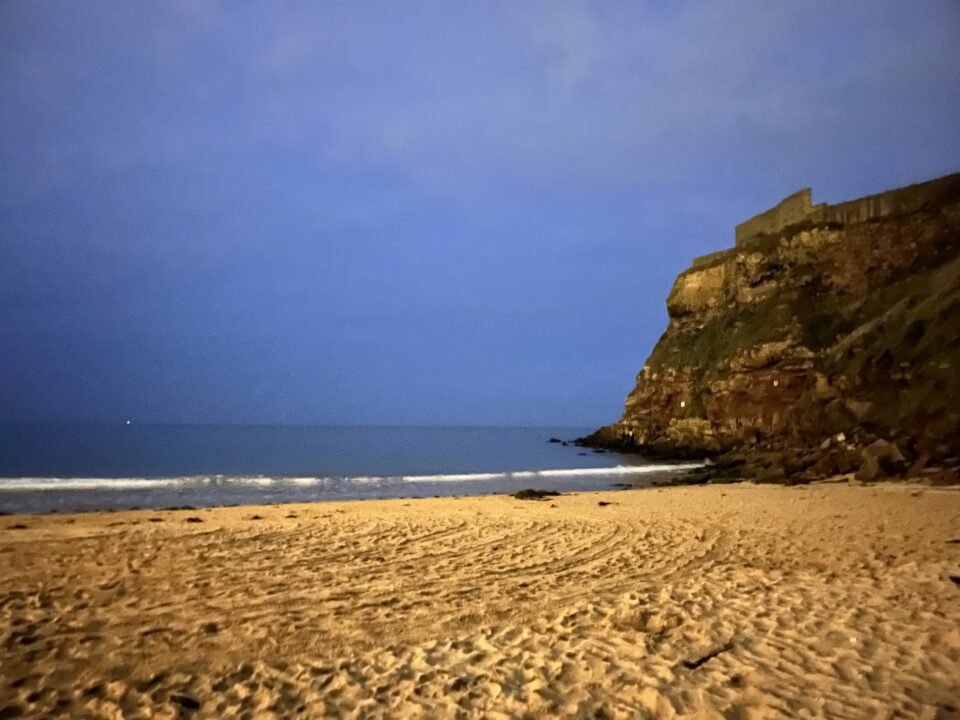
Next weekend, on 31 October, we’ll be holding our annual Dusking event on King Edward’s Bay. It’s a chance to remember those who have died, say farewell to the summer and welcome the autumn and winter. If you fancy joining us, it would be lovely to see you… Look out for the exact details of this next week.
Time is a strange old thing, isn’t it? Losing an hour always feels a little odd. Where does it go?
We have some friends who have a ticking clock in their front room. When there’s no other noise, that ticking becomes incredibly loud. Tick, tock, tick, tock. Relentless. In theory, it never stops. Well, the physical clock might stop when the battery runs out, but the natural world carries on moving through its cycles, and time itself keeps slipping through our fingers.
Although, of course, time itself makes no sound.
Recently, I’ve been reading (or, more accurately, listening to) Elizabeth Alker’s book Everything We Do Is Music. It explores the journey between classical music and techno, and the surprising ways classical music continues to shape and surface in the music we listen to today. It’s a cracking book!
One of the things that has particularly caught my attention is the way Alker explores silence: the pauses between notes, the apparent absence of sound, the spaces in which we might think nothing is happening.
We hear this in some modern electronic music. The sound builds and builds towards a crescendo, until suddenly everything drops away. For a moment, there’s a gap, an almost startling absence. Then the music returns, and we hear it differently because of the silence that came before.
Alker also talks about the night sky. When we look up, our eyes are drawn towards the stars, those little points of light scattered across the darkness. Yet the darkness surrounding them is just as much a part of what we see. And the longer we allow our eyes to adjust, the more stars begin to appear. What initially looked like emptiness gradually reveals itself to be full of things we hadn’t noticed.
I find myself wondering whether there’s something here for us as the clocks change, the evenings draw in and we enter the darker months of the year.
Perhaps that’s one of the difficulties with this time of year. We tend to think of darkness as the absence of light, silence as the absence of sound, and winter as the absence of summer. We describe things by what they lack, rather than by what they might offer.
We can do the same with our own lives. The quiet after someone has died. The space left when a relationship ends, a familiar place changes or a chapter of life comes to a close. We notice what’s missing, and rightly so. Absence can hurt. Grief isn’t something we need to dress up as a gift.
But perhaps the spaces left behind can also teach us something about how we live, love and remember.
That’s part of what Dusking means to me. As we gather by the sea, we remember those who are no longer physically with us. We say farewell to the summer and welcome the darker months. We don’t try to make everything bright or pretend that endings aren’t endings. Instead, we pause together. We make room for memories, for grief, for gratitude and for whatever we carry into the changing season.
And perhaps that’s a little like the silence in music. The pause doesn’t erase what came before it. Nor does it mean the music has lost its meaning. Sometimes, it’s the space that allows us to hear what we might otherwise have missed.
I wonder whether we might approach the coming winter in the same way. Rather than treating the darkness as something to battle until the light returns, what might happen if we gave ourselves permission to inhabit it? To notice the changing sky, listen to the wind, sit beside a fire or simply allow a little silence into our day?
We don’t always have to fill the gaps. (That is a challenge for me)!
Perhaps the world is still making music, even when we can’t immediately hear it. Perhaps life is still unfolding in the dark, even when we can’t see what is growing. And perhaps some things become visible only when we stop looking quite so hard for the light.
So, as the clocks change and we enter another season, I’m going to try to listen a little more carefully. To the music, to the silence, to the sea and to the spaces in between.
Who knows what we might discover there?
Questions
- If you could steal an extra hour from any day of the year, when would you take it and what would you do with it?
- The clocks go back this weekend, giving us all an extra hour. So, what would you do with an entirely guilt-free hour that you didn’t have to be productive with?
- What might change if we stopped treating winter as something to get through?
- Are the pauses in our lives simply gaps to be filled, or might they be part of the music?
- What might we miss when we’re always looking for the light?
- In what ways could an absence still hold a presence?
- What might we discover if we learned to listen differently?
Photo: Rob Wylie

Rob Wylie is the founder of BeachcomberFX and guides its leadership team. He has worked in the North East for over 20 years and has vast experience from various roles he has held. He has a passion for Fresh Expressions of Church and Pioneer Ministry as well as beer, beaches and Miniature Schnauzers.